
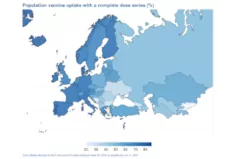
WHO/Europe tracked COVID-19 vaccinations across Europe in an app that collected data from each country. Jumping Rivers supported the app, automating manual tasks and keeping it fast as the data grew.
WHO/Europe tracked COVID-19 vaccinations across Europe in an app that collected data from each country. Jumping Rivers supported the app, automating manual tasks and keeping it fast as the data grew.




Hertfordshire County Council’s Public Health Evidence & Intelligence team required a data science platform to undertake and publish analytics, ranging from creating automated reports describing the population's health to machine learning models predicting hospital admission.




Skills Development Scotland wanted to replace hand-made Excel and PowerPoint research reports with R. We trained the team in R and git while working alongside them on the analysis.



Public Health Scotland (PHS) were moving away from the SPSS programming tool to open source tools such as R and Python, to save on licensing costs and gain the more advanced capabilities R and Python provide.


Utah Tech University came to Jumping Rivers wanting to build two dashboards to help administrative staff and other interested parties better understand their student retention and admission data.


Jumping Rivers reimplemented an existing Shiny app using standard web technologies, achieving Web Content Accessibility Guideline compliance. The Shiny app was divided into a front-end and back-end component, using AWS Lambda to create a scalable and serverless R backend. Infrastructure was codified with Terraform, with the deployment and application life-cycle controlled with GitHub Actions.



How a ten-year R and Python training partnership supports data-driven biomedical research.



The IT infrastructure for Public Health Scotland is managed by National Services Scotland, who came to Jumping Rivers with an existing Posit (formerly RStudio) deployment that was unable to provide a stable and reliable platform at a scale that met the requirements. Issues included inconsistent package versioning, which caused analyses that ran on one node to fail on another.


In spring of 2020 Northumbrian Water engaged with Jumping Rivers to build a modelling solution to better understand risks to the consumer within their network in order to provide a better service.


In the spring of 2018, NHS Scotland expressed a need to move from their existing software, SPSS and SAS, to using R. The difficulty they faced was that there are over two hundred data scientists in NHS Scotland, which made training everyone in the new software a logistical challenge.



Jumping Rivers built a tool for creation of experimental risk assessments via a centralised web application. The dashboard allows for collaborative working during the data entry and assessment formulation, report generation and tracks versions along iterations of the process.

Jumping Rivers created a data pipeline and visualisation dashboard for public and policy maker consumption. The aim was to increase transparency and encourage positive change to the workplace environment. The application allows exploration of key performance indicators stratified by a host of protected characteristics.