

AI consulting
Before you invest, we review your use cases, data and governance and give you a prioritised plan for where AI fits.
Build, deploy and maintain AI systems with confidence.
From machine learning models to generative AI applications, Jumping Rivers helps organisations turn AI ideas into dependable software, combining data science, engineering and validation expertise to keep it reliable in production.





Before you invest, we review your use cases, data and governance and give you a prioritised plan for where AI fits.

Machine learning models and LLM tools, built in R and Python and tested and documented from day one.

Every system is tested against agreed acceptance criteria, with the evidence your quality team and regulators expect.

Proofs of concept become tested, version-controlled software your team can maintain.

Our courses give your analysts and developers the skills to build with AI and to question its output.

After launch, monitoring shows your models still meet their criteria as data and LLMs change.














Tools that summarise, extract and draft from the documents your teams work with every day, such as reports, protocols and correspondence, with a person reviewing the output before it is used.

Question-and-answer applications grounded in your own data and documents, which show the sources behind every answer so users can check them.

Machine learning models for forecasting, classification and anomaly detection, built in R or Python and tested so you know how they behave before anyone relies on them.

Models and LLM features built into the tools you already use, including Shiny apps, Quarto reports, data pipelines and Posit Connect, so AI supports your current processes rather than sitting beside them.

Most organisations already have AI in use. The question has moved from "can we use AI?" to "how do we show it works?", and from "which tools should we buy?" to "is our team ready to use them?" We answer both by treating AI like any other system that informs a decision. For organisations earlier on, we also support wider digital transformation, from modernising legacy tools and data to building the skills to adopt AI well.
Risk-based validation for AI used in statistical programming, data review and document work, with evidence that fits your GxP processes and GAMP 5 (second edition) principles.
Explainable models your own team can run, documented in a way that supports the Algorithmic Transparency Recording Standard and avoids vendor lock-in.
Analysis and training for institutes and public health bodies that need rigorous, reproducible work. We have built data science capability across more than 100 researchers at the Francis Crick Institute and support Public Health Scotland's move to modern, open tooling.






Our trainers are practising data scientists, so courses are built around the problems your team will face. Every course can run privately, on-site or online, with examples from your own domain.
View course catalogue
Want to see how others run AI in production? Our annual conference brings together people building, deploying and maintaining AI systems in industry, government and research, with a focus on what happens after the prototype.
Visit the conference siteFree sessions from our monthly webinar series, recorded and ready to watch.
 Play webinar: A First Look at Positron and Posit Assistant
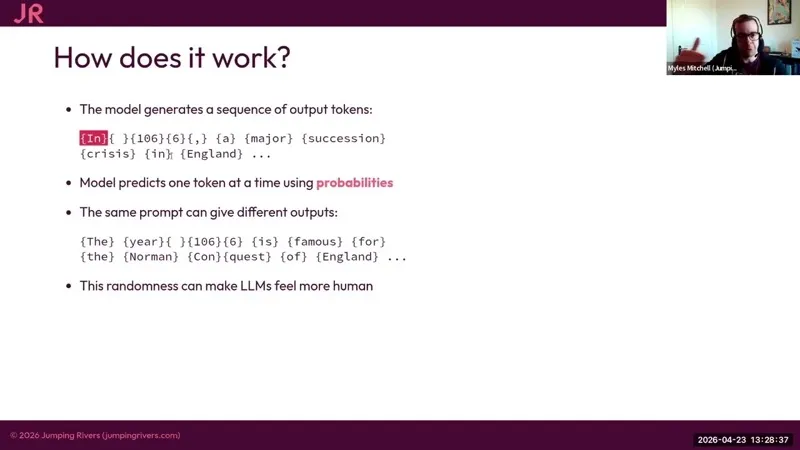 Play webinar: Programming with LLMs in R & Python
 Play webinar: Machine Learning with Python
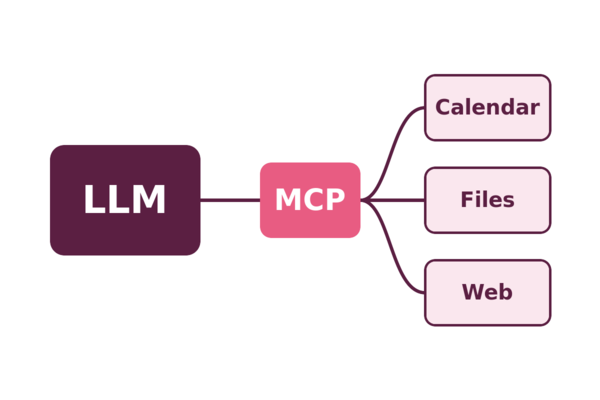
Model Context Protocol (MCP) is quietly becoming one of the most useful ideas in AI tooling. Here, we describe what MCP is, why it matters, and how to build an MCP server yourself.

Learn about retrieval-augmented generation (RAG) workflows for large language models. This blog provides a hands-on introduction, including example code for creating a working knowledge store using open source packages in R.
Part 4 of our series of blogs on vetiver for MLOps. Having previously explained how to set up an MLOps workflow in R, we now turn to Python. This blog will introduce the vetiver package for Python and outline the key MLOps steps including model versioning, deployment and monitoring.
Whether you have a model to build, a proof of concept to productionise or a system to validate, we'll help you find the right place to start.